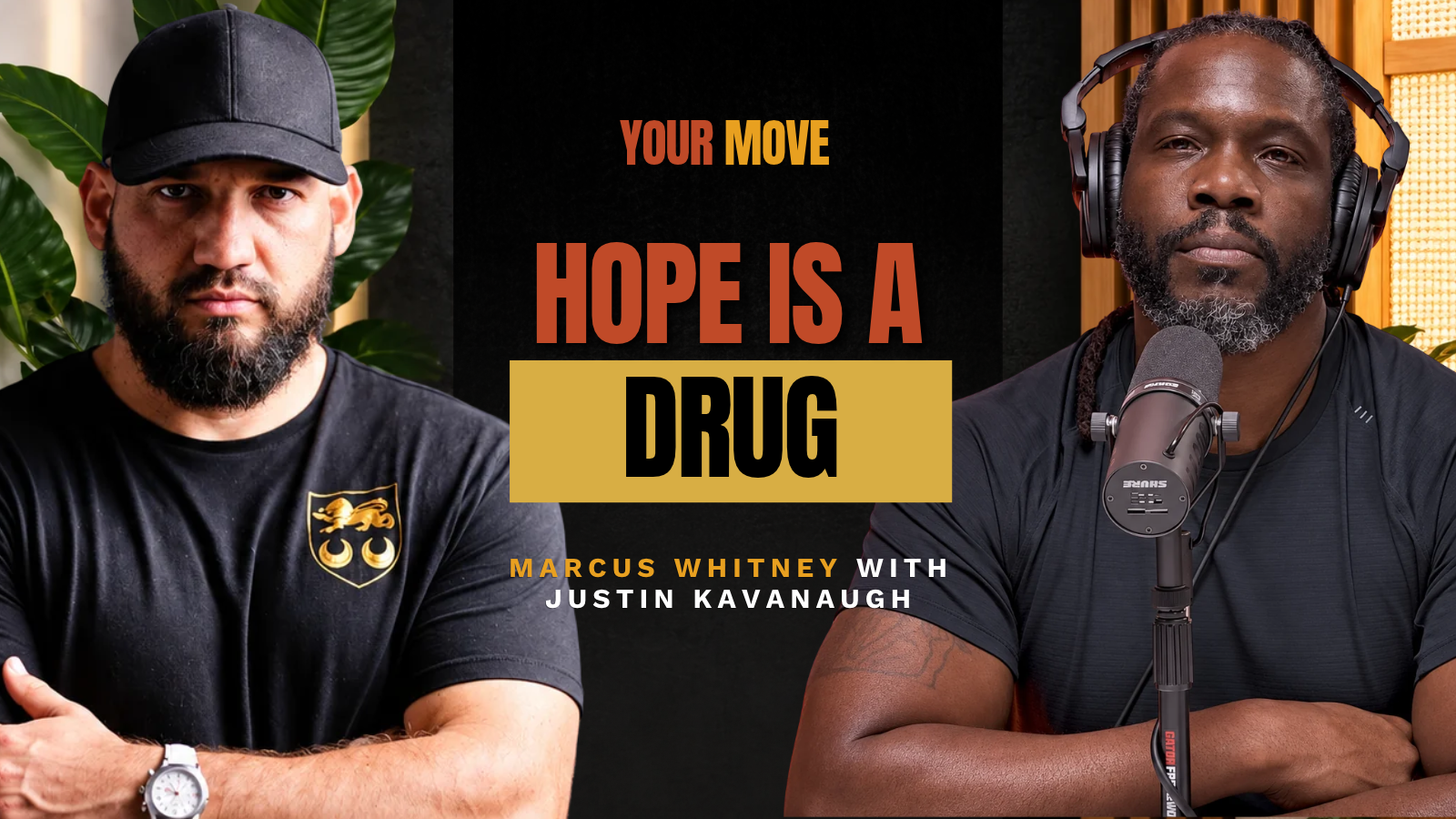
A five-sport athlete broke his back trying to make it as a player. What he built instead reached six Olympic Games.
Justin Kavanaugh fell through a roof and broke his back.
L4. L5. T1.
He could not walk.
His father, a firefighter, carried him to the bathroom.
Justin was nineteen.
Justin is a six-time Olympic Games coach across six consecutive cycles. He has trained 47 world champions and personally coached more than 50,000 athletes, among them Olympic gold medalist Justin Gatlin, Yohan Blake, and four-time Tokyo medalist Nick Mayhugh. He is the bestselling author of Man Up and is finishing a second book, The Gap: How to Win. He built his first performance company while he was still in school, grew it into one of the country’s most respected training organizations, and later founded Sites at Scale, which now serves more than 1,500 entrepreneurs.
That is the resume. On Your Move, none of it was what I wanted to talk about.
I wanted to talk about the fall.
The identity break
Justin was a five-sport athlete and a high school All-American. In first grade, he drew a self-portrait for a class assignment. He put himself in a hat and a whistle.
At the time, he thought the picture meant coaching came after playing. First the NFL. Then the millions. Then giving it back to the world.
He committed hard to one path and one school. Miami never recruited him. He went to Virginia Tech instead, and the only coach honest enough to warn him what was coming was Ben Foster.
“You’re high school All-American. That’s great. So is everybody else that’s here. You’re going to come here. You may get red shirted. You’re going to play special teams,” Foster told him.
Justin thought Foster was the one being unrealistic.
He wasn’t.
His college career lasted, in Justin’s own words, about as long as a cup of coffee.
Then came the roof.
“It was not catastrophic,” Justin says. “It was almost life-threatening.”
Then he names what actually broke him.
“It wasn’t the physical part,” he says. “It was the identity that really messed me up.”
“I’ll sometimes look in the mirror,” he says now, “and go, oh my god, who’s that guy?”
Six to nine months later, he told his father he was ready to try again. His father said yes without resistance. His mother asked if he had lost his mind.
He bought the plane ticket anyway.
A move is any action you take when you can’t see where it leads.
He hurt his back again.
That was the real shift, the second injury, not the first.
“I can’t work on other people’s schedule anymore,” he realized. “The world of sport is on the team’s timeline. But the world of your stuff is on God’s timeline.”
The honesty test
Years later, on the podcast, Justin said something rare about the thing that ended his career.
“The reason why I didn’t play in the NFL is I just didn’t have it,” he told me. “There’s plenty of people that got hurt worse than me and then came back and made it.”
No injury story. No blame. Just the truth he needed to build the rest of his career on.
I trust you
Before the injury had even fully sunk in, Justin was training a teammate, an older athlete who discovered his own manager and agent were stealing from him.
The conversation was short.
“If I could call you at two in the morning if I needed something, then I should be able to call you for my career,” the teammate told him. “I trust you.”
Justin didn’t fake expertise he didn’t have.
“I don’t know this,” he told him, “but I do know one thing. I believe in you.”
That was the actual beginning of a twenty-year coaching career. It began with a phone call and an honest answer, not a plan.
The yes on the sideline
A few years on, Justin was standing around a University of Miami practice field, not competing, just present, when a coach named John Brock walked over and asked if he wanted to coach.
Justin said one word.
“Yep.”
Then he backed himself in front of the linebackers coach already running the drill.
“I’m better than what you got out there,” he told him. “Let me go in there and work.”
He was right. That coach became a lifelong friend.
Every moment was the moment
Here is the mechanic underneath all of it, the thing Justin now repeats to every athlete he trains and every entrepreneur who hires him.
“I acted as if the big time was everywhere my feet were,” he says. “I treated every event as if it was the Super Bowl for me. Because of that, when I went to the Olympic stage, I was ready for the moment.”
He didn’t get ready to get ready to get ready.
“I stayed ready,” he says, “because every moment was the moment.”
The second mountain
These days Justin calls himself a bridge builder. He helps people who already reached one summit find the next one.
“This idea of telos is this man’s search for higher purpose,” he says.
He has coached a three-time Olympian in his thirties who built his country’s medal count and came home to less respect than the criminals there receive. He has coached Yohan Blake, the second-fastest man alive, who takes his winnings back to Jamaica anyway.
“Jamaica may not recognize me for my greatness on the track,” Blake told him. “I’m going to use my track success to take care of this because it’s my home.”
Reaching the summit doesn’t answer the question of what you climb next. Justin’s entire second act is built on that gap.
Your move
Maybe your move looks like Justin’s: walking away from the identity you built your whole life on and finding out you were something else the whole time.
Maybe it’s smaller and harder: telling yourself the true reason, the one you have been avoiding, instead of the story that lets you off the hook.
“Hope is a drug. It’s not a strategy.”
A move doesn’t have to be big. It just has to be yours.
Listen to the full conversation with Justin Kavanaugh wherever you get your podcasts, or watch it on YouTube. And when you make your move, tell me about it. I read every one.
Your move.